Where Does the Name Eobokjaengban Come From?
Eobokjaengban is a Pyeongyang dish of beef cuts laid out on a wide tray and simmered in broth, despite a name that sounds as though fish were in it. At Seogwanmyeonog the tray holds Hanwoo (Korean beef) shank, head meat, ox tongue, tripe, udder, large intestine, spleen and pan-fried lung.
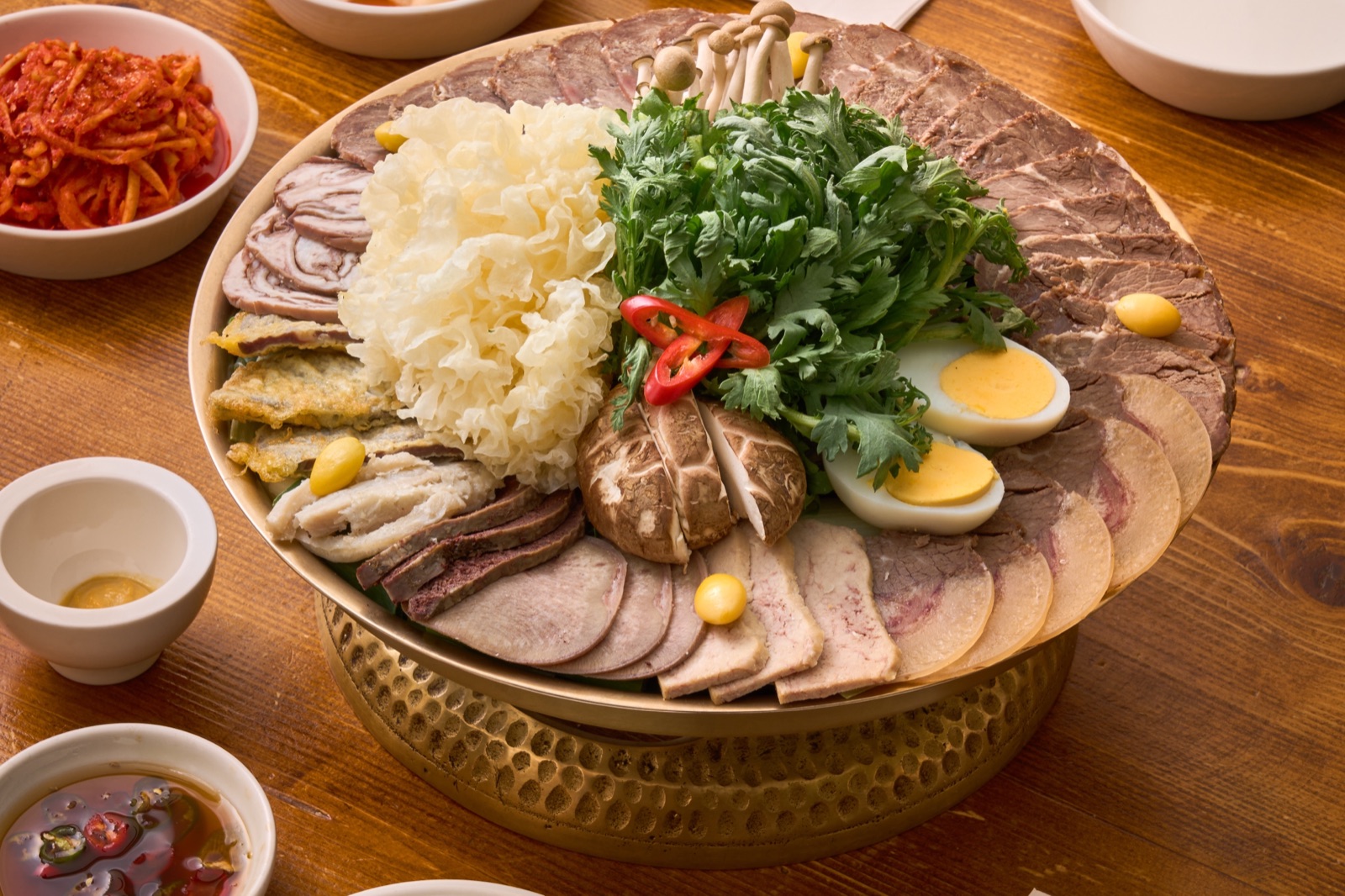
Hearing the name Eobokjaengban for the first time, it is easy to assume there is fish in it. Eobokjaengban is in fact a Pyeongyang dish of several cuts of beef laid out on a wide tray and simmered together in broth.
At Seogwanmyeonog we set out Hanwoo (Korean beef) shank and head meat, ox tongue, tripe, udder, large intestine and spleen, together with pan-fried lung, add mushrooms and vegetables, and pour in the broth to simmer.
What Does Eobok Mean?
Several stories are told about where the name Eobokjaengban came from.
One of them holds that ubok, a word for the belly of an ox, shifted in pronunciation over a long stretch of time and became eobok. In that reading the name comes from the nature of the dish itself, a gathering of many cuts of the animal eaten in one place. The exact origin is not settled on a single account so much as carried down in several versions, so rather than fix on one of them, we keep our attention on the name and the form of a dish that has come down from Pyeongyang.
A Dish Eaten Around One Tray in Pyeongyang
Eobokjaengban is a dish that several people simmer and eat together, with a wide tray set in the middle. Tasting a little of each cut and topping up the broth as it runs low, eating slowly, sits well with the food culture of Pyeongyang, where a table is shared along with the drinks. It also makes a good way to experience Seonju Humyeon (a drink first, then noodles) at Seogwanmyeonog, with the meat alongside the drinks and noodles at the end.
Eobokjaengban at Seogwanmyeonog
We carry on what defines Eobokjaengban, the range of beef cuts, the wide tray, and the way it is simmered and shared. From Hanwoo shank and head meat to ox tongue, the offal cuts and pan-fried lung, the tray is arranged so that different flavors and textures meet in one place, with mushrooms and vegetables added and the broth brought to a simmer. Unlike suyuk (boiled beef slices), where you taste a single cut, Eobokjaengban lets you meet several cuts of Hanwoo at one sitting, and that is part of its appeal.
Food with a story behind it, Eobokjaengban among them, is something we keep talking about at Seogwanmyeonog on Instagram.
Frequently Asked Questions
- Is there fish in Eobokjaengban?
- No. The name makes it easy to take for a fish dish, but it is various cuts of beef simmered in broth with mushrooms and vegetables.
- What does eobok mean?
- Several accounts of the origin are told. One of them holds that ubok, a word for the belly of an ox, shifted in pronunciation over time and became eobok.
- Which cuts of meat go into Eobokjaengban at Seogwanmyeonog?
- Hanwoo shank, head meat and ox tongue, along with tripe, udder, large intestine and spleen, together with pan-fried lung.
- Does Eobokjaengban go well with a drink?
- Yes. Simmering the various cuts slowly over a drink and closing with naengmyeon follows the flow of Seonju Humyeon, a drink first and then noodles.
References
- Encyclopedia of Korean Culture, entry for Eobokjaengban
- Seogwanmyeonog menu stories (/en/story)